Tuesday, February 7, 2012

Artists Are Not Like Software Engineers

As mentioned in a previous post, last year I joined an artist studio after having spent more than 20 years in high tech. While I've rubbed elbows with artistic types in the past, I've never been in a work environment with them before, and although this may not come as a surprise to you, what amounts to a revelation to me is this: Artists are not like software engineers.**

This fact first dawned on me during the studio annual meeting (required by regulation because of the studio's LLC status), which was held right after I joined. I'm used to business meetings being called and driven by a major stakeholder or owner of the project under discussion, or at least someone who has a lot of skin in the game. This person sets a formal agenda and keeps people focused on its points during the meeting. The goal is to reach agreement on how each point is to be addressed, and to assign action items to participants. Following the meeting, the owner follows up to make sure each action item is addressed and closed on and the results circulated to the meeting attendees according to an established timeline. (And of course, the fact that time is of the essence goes without saying.) 

I submit that if you're a business professional, you've probably read the previous paragraph and thought, "And...?" But if you're an artist, you're likely squirming in discomfort entertaining the image of such an environment, and mentally looking for the Exit door. I could be wrong about this, of course, as I'm just in the learning phases about how artists experience such things. But at least based on my observations so far, artists don't tend to be nearly as linear in their thinking and their goals tend to be somewhat open-ended, allowing for unexpected things to occur. Serendipitous Things. Not that either approach to conducting one's particular type of business is better or worse than the other. The two are just very, very different. 

So, back to my first studio meeting. There was a suggested time for us to get together, and when everyone had arrived, about 20 minutes or so after the suggested time (I was probably the only one who noticed), someone suggested that we look at the LLC documents to see what we were supposed to do. The documents were found and dug out of their folder, and it was determined that we needed to elect officers. The current president called for volunteers, and one person volunteered for each spot, while another person wrote down their names and positions on a piece of paper. Because we had a new treasurer, there was some discussion about the bank account and how money was collected and deposited. The departing treasurer indicated that people new to the LLC should go to the bank and sign the signature card. Next, the discussion turned to our studio party and somehow (I was unable to sort out how it happened) the date was picked, and a menu decided upon. 

During the entire meeting, I was certain that nothing was going to emerge from this loosey-goosey approach but chaos, but fortunately had the good sense to keep my mouth firmly shut. After a surprisingly short period of time, the business part of the meeting faded into a purely social time, and that was that. Six months later, I can report that everything was carried off flawlessly, and with no fuss whatever. In fact, the way the studio operates is awesome, but I won't take more time for that here. I think I'm still a bit shocked. 

So here's my attempt at a visual illustration of the two types of meetings. Interestingly, both software engineers and artists like to draw pictures (although software engineers like to call them "diagrams").

Typical Business Meeting in High Tech

Annual Studio Meeting
** Disclaimer: Of course, I realize that no person is purely artist or purely software engineer, or purely anything else for that matter. Individuals are always a mixture, and imposing stereotypes ensures that nuances will be missed. Nevertheless, I'm going to do it anyway because, taken as a group, IMHO artists are in fact very different from software engineers.

You might also enjoy:
  • Overcoming Fear of Paint  -  Someone once said to expand your abilities and horizons, you should do one thing a day that makes you afraid.
  • More Fear of Paint - I'm still putting lots of paint on the page while holding my breath.

Wednesday, February 1, 2012

Robin's Sketchbook, Children

Here are some more pages from Robin's sketchbook, most of them with her notes as captions. This time the theme is "children." Robin is both mother and teacher, so she has lots of time to observe them in school and at play.


Another fun week of school!

Imagine feeling so cool in your bike helmet--that you wear it all day at work as these children did at school! The bikes were used in gym that week...
The school year is almost over!
Going to a high school soccer game.

A sunny day! 


A stop at the Greenwood Library.

The students came to school today with Halloween costumes in their bags. It was lively all day! The candy wrappers will be crinkling tomorrow!

The Methow Valley was sunny and charming. From the roads up to the mountains for day hikes----it was beautiful!

You might also enjoy:

Saturday, January 28, 2012

Artists of the First Nations

While my daughter and her boyfriend were visiting from Australia this week, we spent a few days in Vancouver, BC. One afternoon we went to the Museum of Anthropology at the University of British Columbia. Containing more than 38,000 objects, the museum is more than a bit overwhelming, so I decided to focus on the First Nations collection, totaling just 6700 objects (!). First Nations are the indigenous peoples of North America who have lived here for about 10,000 years. In the Pacific Northwest much of their tradition and culture has managed to survive* in spite of the concerted and ongoing efforts of European settlers, arriving in the 18th century, to eradicate it. Over the last decade or so, First Nations culture has finally attained a degree of respect.

Upon entering the museum we found ourselves in a lofty vestibule full of First Nation objects ranging from totem poles to canoes to wooden cooking boxes, all carved from Pacific Coast Cedar. After several minutes of walking around in rapt appreciation, I realized my mouth was wide open. I closed it, but it soon opened again for yet another, "Wow!"


Liz inspecting interior house posts

Left - woven rug, back right - wall decoration, front right - funeral box for a  chief.

Carved poles were always painted, but most of them have long since lost their paint. This is a happy exception.

Ancestor figure.

Haisla canoe
Traditionally, First Nations people lived along the coast and next to waterways, as the inland forests were (and mostly still are) too dense for easy travel on foot. Their art and craft included no pottery, but rather relied on the wood and bark of the abundant cedar tree for nearly everything, even cooking pots and clothing. For weaving, they also used marsh grasses, in addition to bark.
Totem poles
Looking at this collection I was struck by the integration of art into the everyday things used by these people. Each item in the collection was beautifully formed, carved, and/or painted.

I finally tore myself away from the larger carvings and entered a series of smaller rooms filled with glass-enclosed shelves laden with myriad smaller, but equally artful, objects.

Cedar bark basket

I don't know what this carving might have been used for. Perhaps it was simply decorative.

This was worn about the neck, probably for ceremonial purposes.

Wouldn't this be a fabulous masquerade mask?

I can only try to imagine what these represented. Any ideas?

Beautifully carved ladles for trade.

Haida hat.
* The art of carving totem poles has been passed down and continues to this day. For examples, see John Joseph, Norman Tate, Harold Alfred, and Robert Davidson. 

You might also enjoy:

Friday, January 20, 2012

Robin's Sketchbook, Seattle Icons

There's a lot of interest among artists in sketch-booking these days. It's fun making sketches and people love looking at them, too. Robin Robins, a member of our watercolor meetup group, showed us her sketchbook the other day, and I enjoyed looking at it so much that I asked if I could share it with you, which she has generously agreed to allow.

I have a total of 30 photos of her sketches, which is far too many for a single post, so I'll divide them up and dribble out in smaller batches. For this post, I decided to share her Seattle icon sketches. Thanks, Robin!

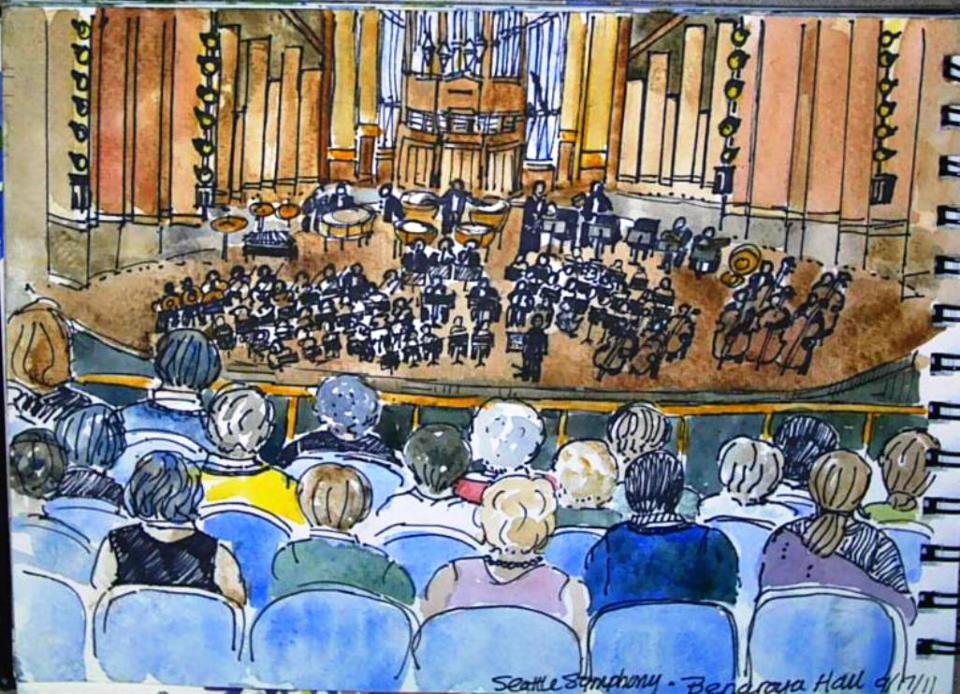
Seattle Symphony playing in Benaroya Hall

Seattle Art Museum and the giant Hammering Man sculpture

Seattle Opera House

No eclectic collection of Seattle-abilia is complete without Pike Place Market 

King Street Station

Ivar's Salmon House

Walkway around Greenlake
Swimming and boating in Greenlake
You might also enjoy:


Thursday, January 19, 2012

Gate C

A story - Sometimes patience pays off, and sometimes it doesn't.

When I got there, the Gate C exit area was deserted. Good. It would be easier to detect the beginning of the next wave of arrivals and start the process of judging where they’d come from.  A small group appeared from the gate area and proceeded through the large exit door. I examined them closely, looking for clues to their place of origin, but they could have come from anywhere, wearing or carrying jackets and coats appropriate for the Seattle winter, and having nondescript skin tones, with no evidence of recent sun exposure. The first group was followed by a succession of others just like them.

My attention began wandering, and without its discipline, my thoughts tumbled recklessly: “She’s almost here! I’ve missed her so much. She’s living her destiny that I somehow always expected. My intuition knew she’d live on a far away continent, and soon I’m going to see her again after more than a year.”

Teary eyes would not do for a greeting. I forced my attention back to watching the exit.

A man standing nearby shook his head and walked over to the escalator leading down to Baggage Claim. I fished out my cell phone and checked the time. It was a long walk from the gate to the exit, and barely 10 minutes had passed since the plane’s arrival. Even so, I felt compelled to ask the guard standing nearby if there was another way out from Gate C. No, he said. No other way.

I returned to my station and looked around the terminal, composing mental pictures of it to keep my mind occupied until the next wave of arrivals. A man and a woman walked over from the ticketing area and stood a few feet to my right. 

I lifted my left foot a couple of inches from the floor and rotated it, then shifted to my right foot and did the same.

Another group began trickling through the exit. A bright floral-print shirt caught my attention. Next came a face with a leathery tan followed by a Hawaiian shirt, and finally the clincher, a silver jacket and matching silver flip-flops. The plane from LA.

My heart beat faster, and I took a deep breath to slow it back down. Eyes started to water again, so I focused intently on faces. Time passed. A tall man towered over the crowd. Was that an Acubra on his head? No, it wasn't her partner, Jim. Back to faces. Their numbers dwindled. How curious. Under the weight of a sinking heart, my feet stopped shifting and felt rooted to the floor.

The couple to my right put their heads together in discussion. “What plane are you waiting for?” I asked.

“The plane from LA,” the woman replied. “I’m going down to baggage and see if we missed them.” She disappeared down the elevator. After a few minutes she was back. “They’re all down in baggage.”

Forgetting to thank her or even look back, I dashed to the escalator.


You might also enjoy:

Saturday, December 17, 2011

Sketching on Location

Sketching on location -- making quick studies of a subject -- is a great way to develop and practice skills as well as record ideas for more complete painting or drawing. It's also a way to record the light and shadow patterns in a scene before the rapidly moving light source (sun) changes them, or make note of a particular color that a camera may not quite capture. For these reasons, many artists won't leave home without their sketchbooks.

Here are a examples of the different ways I've used such sketches in my art process.

Value sketches are usually monochromatic. Their purpose is to help you decide on the relative values of the different objects in the composition. You can check your overall composition at the same time. In this value study, I decided that the horizon needed to be lower (as I noted with an arrow).

I lowered the horizon in this second sketch to see if I liked it better. I also adjusted some of the values.

In this example I tried three different compositions.

Here I tested ideas for a birthday card I wanted to paint for a friend. I liked the drawings on the bottom the best, so I added color, and then finally decided to use the stair concept for the card.

This was a value study for my three Japanese Teahouse watercolors.

In this sketch, I recorded the interesting edges of the plant.

This ultra-quick sketch captures the motion of the kangaroos.

And again.

This sketch focuses on the back-and-forth movement of the elephant's trunk and the twitching of his ears and tail.

Here I was trying to decide if this view of my living room would make a good composition.

Here's a painted sketch of the shadow shapes in a scene. I wanted to be sure to include these shadows in the final painting. The light and shadow in a scene can create framework that's an important part of the composition.

Here's another painted sketch of shadows only.
Sketching doesn't have to be for a particular purpose, though. Sometimes I like to get together with other artists and sketch for fun. There are many opportunities to sketch in more organized ways. For example, Michele Cooper, who keeps a wonderful sketchbook, participates in the Sketchbook Project. 

Sketchbooks on display for the Sketchbook Project. 
Several other artist friends take part in Urban Sketchers, which is a group that gets together to sketch in various locations. Also, Catherine Gill hosts a weekly group called Art on Tap, where artists meet at a local pub three Monday evenings a month to sketch. Maybe I'll see you there!


You might also enjoy: