Monday, May 7, 2012

What's the What and So What?

I recently attended a painting workshop given by Catherine Gill, a wonderful artist and teacher from Seattle. You may be familiar with her recent book, Powerful Watercolor Landscapes, which is one of the very best books of its kind that I've ever read, and simply loaded with jewels of wisdom based on Cathe's 30 years as painting instructor.

Cathe Gill demonstrating
If you've read her book, or even heard her talk, you'll know that one of Cathe's signature expressions is "What's the what?" Before this workshop, I'd never taken a class with Cathe, but I'd certainly heard this phrase plenty from my studio mate, Mara Bohman, who's taken more than one. Mara would look at my work and exclaim, "What's the what? What IS the what??!"

Simply stated, the "what" in a painting is the thing that draws the viewer's eye first -- the most important thing in the picture. Without a clear "what" the viewer is likely to skim over the painting and move on. As I often didn't have an answer to Mara's question, I decided to really focus on this "what" business during the workshop and learn more about how it can help improve my artwork. It turns out there are various methods artists use to draw the viewer's eye, including:
  • Value contrast-- The lightest light and the darkest dark placed next to each other, or at least near each other, draw the eye. The less the value contrast in an area, the less the eye is attracted to it.
  • Shape - A big or complex shape can help define the "what."
  • Color contrast -- Complementary colors placed near each other attract the eye. Complementary colors are those on opposite sides of the color wheel, for example red and green, blue and orange, purple and yellow.
  • Edges -- Rough edges. These attract the most attention in a watercolor, so should be placed where you want the most attention. Next are the hard edges, and finally the blurry edges, which should be placed in the parts of the painting that are less important.
  • Details -- Small marks also draw attention, so details should be reserved for the "what" part of the painting.
Cathe says that using just two or three of these elements is plenty to define the painting's what. The artist can reserve the others for the parts of the painting where the viewer's eye can travel after it visits the "what."
Cathe's reference photo
Here's Cathe's demo painting. Where is her "what"? Can you tell which of the methods listed above she used to attract your eye to it?

Sunday, April 22, 2012

Golden Times

Last night Bill and I attended a concert at Seattle’s Town Hall in which the musicians played medieval instruments. One such instrument was a ceng. Looking and sounding a bit like a modern harp, the ceng was played with such sensitivity that, as the music floated up from it, I found myself mentally hanging onto each note as if doing this would somehow freeze it in my mind. After a few moments, though, I realized that clinging to one note prevented me from hearing the next, and that to enjoy all of the music, I had to let each tone  freely pass through me as it was played.

In a similar manner, I've found myself wanting to preserve a golden time of my life -- to stop the clock and forestall the end of a wonderful, but transient era -- playing with my children, romping with the dogs on our little farm, hiking with a group of “empty nester” friends, and, lately, painting with fellow artists and enjoying time with my husband Bill, a happy addition to my life's second act.

After all, just like the notes of the ceng, each golden moment recedes into the past much too quickly. But continually looking back and clinging to a passed experiences would keep me from enjoying the ones to come, so instead I remind myself to savor each moment as it moves through my life -- and then let it go.

"Best Friends" (c) 2009-2012 by Megan Davis Seagren

Saturday, April 21, 2012

Time to Paint Outdoors!

Hurray! It's that time of year again, when painters dust off their plein air gear and head outdoors. I'm gathering information about plein air groups in the Seattle area, and updating the information on the Plein Air tab above. If you know of a groups that's not on my list, please comment on this post and I'll add it. Thanks!

"Old Stump," (c) 2009-2012 by Megan Davis Seagren


Thursday, February 16, 2012

Robin's Sketchbook, Travels Near and Far

Robin loves to travel near and far, and lucky for us, she makes watercolor sketches of her adventures. Here are some of them. 

Diamond Head, Oahu Island, Hawaii

Somewhere in Central America
A Grey Whale swimming along the shore of Whidbey Island, Washington.
Around Seattle
Chautuaqua, New York
Mexico
Mexico
Chautuaqua, NY
Portland, Oregon
Occupy Seattle
You might also enjoy:

Thursday, February 9, 2012

An Excursion to the Flower and Garden Show

This morning my friend Liisa and I paid a visit to the Northwest Flower and Garden Show. Liisa worked on the "Bird Song" display garden, created by the Arboretum at Washington Park and the Seattle Audubon and wanted to go back today as a spectator instead of worker to take photos for her fabulous blog, the Intercontinental Gardener. Liisa's already got some posted, so I won't duplicate things she's already covered.

[Photography Geek Note: Bill just bought a fixed F1.8 35mm DX lens, which I wanted to try out at the garden show because of the low light. The lens worked well, except I didn't always get the right thing in focus. If I had to do it again, I'd manually focus everything. Also, because of the low light, the depth of field had to be so shallow in some shots that the photos just didn't turn out well. I guess that's the price you pay for not using flash.]

Anyway, here are a few of the many things that caught my eye:
Colorful hand-blown glass galore, for garden and in-home use. If you're into glass, this is a great opportunity to see A LOT of it. 
Dan Robinson, of Elandon Gardens. It's really hard not to be a groupie, so I just am. He is the rock star of bonsai. If you ever get a chance, get yourself down to Port Orchard to see his nursery. It's worth the trip, believe me! 
What we won't do for art! Liisa has gotten permission  from Dan Robinson to move his "Gold Medal" award so she can get a clear show of this impressive root that he somehow managed to get into the convention center. 
Liisa photographing the gigantic tree root. Hopefully she got a better shot than I did.
This is part of the Arboretum "Bird Song" display. They created a beautiful, natural bird habitat, mostly  out of native plants, and put some bird replicas in it. If you're thinking about making your own wildlife habitat, this display will give you some good ideas. For more on that subject, see Gardening for Wildlife.
Another habitat shot.
A beautifully formed Japanese maple. It's obviously been shaped and pruned over the years.
I want a garden shed like this in my backyard!
The best photo ops were of the flower arrangements. 
A french horn and a willow variety that has flat branches. Very fun.
I don't know what these little yellow puff ball things are, but I like them a lot.


This was so cute, I included it even though it wasn't all in focus.
And last, but not least, my personal haul. Bill's going to be digging some new holes this weekend.
You might also enjoy:

Tuesday, February 7, 2012

Artists Are Not Like Software Engineers

As mentioned in a previous post, last year I joined an artist studio after having spent more than 20 years in high tech. While I've rubbed elbows with artistic types in the past, I've never been in a work environment with them before, and although this may not come as a surprise to you, what amounts to a revelation to me is this: Artists are not like software engineers.**

This fact first dawned on me during the studio annual meeting (required by regulation because of the studio's LLC status), which was held right after I joined. I'm used to business meetings being called and driven by a major stakeholder or owner of the project under discussion, or at least someone who has a lot of skin in the game. This person sets a formal agenda and keeps people focused on its points during the meeting. The goal is to reach agreement on how each point is to be addressed, and to assign action items to participants. Following the meeting, the owner follows up to make sure each action item is addressed and closed on and the results circulated to the meeting attendees according to an established timeline. (And of course, the fact that time is of the essence goes without saying.) 

I submit that if you're a business professional, you've probably read the previous paragraph and thought, "And...?" But if you're an artist, you're likely squirming in discomfort entertaining the image of such an environment, and mentally looking for the Exit door. I could be wrong about this, of course, as I'm just in the learning phases about how artists experience such things. But at least based on my observations so far, artists don't tend to be nearly as linear in their thinking and their goals tend to be somewhat open-ended, allowing for unexpected things to occur. Serendipitous Things. Not that either approach to conducting one's particular type of business is better or worse than the other. The two are just very, very different. 

So, back to my first studio meeting. There was a suggested time for us to get together, and when everyone had arrived, about 20 minutes or so after the suggested time (I was probably the only one who noticed), someone suggested that we look at the LLC documents to see what we were supposed to do. The documents were found and dug out of their folder, and it was determined that we needed to elect officers. The current president called for volunteers, and one person volunteered for each spot, while another person wrote down their names and positions on a piece of paper. Because we had a new treasurer, there was some discussion about the bank account and how money was collected and deposited. The departing treasurer indicated that people new to the LLC should go to the bank and sign the signature card. Next, the discussion turned to our studio party and somehow (I was unable to sort out how it happened) the date was picked, and a menu decided upon. 

During the entire meeting, I was certain that nothing was going to emerge from this loosey-goosey approach but chaos, but fortunately had the good sense to keep my mouth firmly shut. After a surprisingly short period of time, the business part of the meeting faded into a purely social time, and that was that. Six months later, I can report that everything was carried off flawlessly, and with no fuss whatever. In fact, the way the studio operates is awesome, but I won't take more time for that here. I think I'm still a bit shocked. 

So here's my attempt at a visual illustration of the two types of meetings. Interestingly, both software engineers and artists like to draw pictures (although software engineers like to call them "diagrams").

Typical Business Meeting in High Tech

Annual Studio Meeting
** Disclaimer: Of course, I realize that no person is purely artist or purely software engineer, or purely anything else for that matter. Individuals are always a mixture, and imposing stereotypes ensures that nuances will be missed. Nevertheless, I'm going to do it anyway because, taken as a group, IMHO artists are in fact very different from software engineers.

You might also enjoy:
  • Overcoming Fear of Paint  -  Someone once said to expand your abilities and horizons, you should do one thing a day that makes you afraid.
  • More Fear of Paint - I'm still putting lots of paint on the page while holding my breath.

Wednesday, February 1, 2012

Robin's Sketchbook, Children

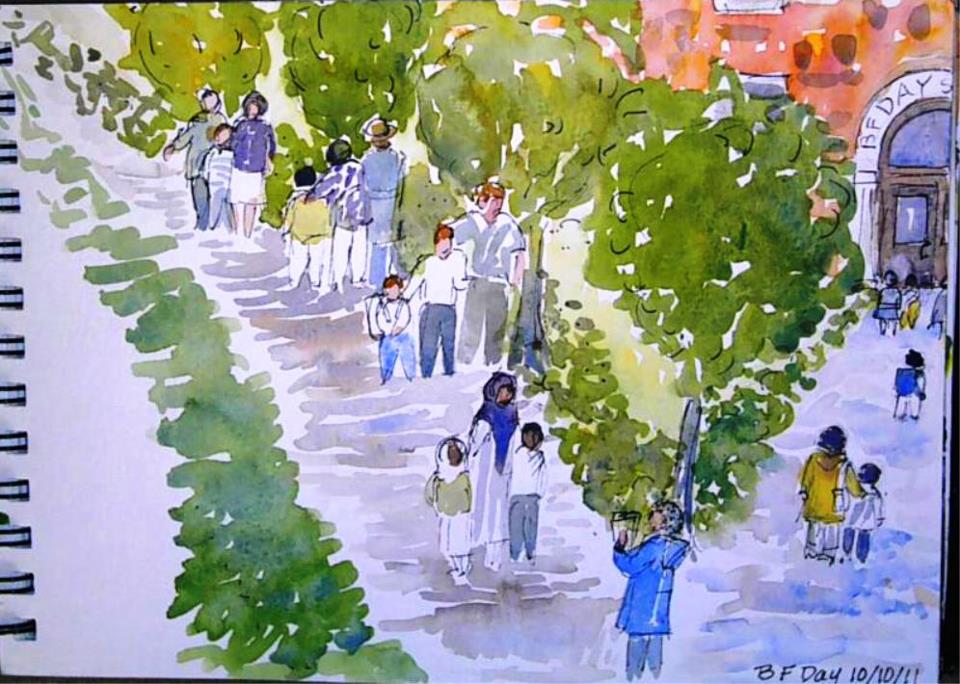
Here are some more pages from Robin's sketchbook, most of them with her notes as captions. This time the theme is "children." Robin is both mother and teacher, so she has lots of time to observe them in school and at play.


Another fun week of school!

Imagine feeling so cool in your bike helmet--that you wear it all day at work as these children did at school! The bikes were used in gym that week...
The school year is almost over!
Going to a high school soccer game.

A sunny day! 


A stop at the Greenwood Library.

The students came to school today with Halloween costumes in their bags. It was lively all day! The candy wrappers will be crinkling tomorrow!

The Methow Valley was sunny and charming. From the roads up to the mountains for day hikes----it was beautiful!

You might also enjoy: