Showing posts with label Wildlife. Show all posts

Monday, October 20, 2014

A Native Shade Garden in Sydney -- Year Two

Native shade garden in Sydney, Australia -- Year Two

In April 2013 I visited my daughter, Liz, in Sydney, Australia, and wrote a post about a native shade garden she was planting. Liz has continued working on the garden, and here's her update on progress:

Phase I is now complete!


I'll start with the failures:


Not everything has worked in this garden, and bush turkeys were a big issue initially. Because they forage in the soil, they are particularly drawn to areas that have been recently disturbed, and if the plants are too small (less than about 30 cm), the turkeys will pull them out by their stem or just snap them in half. The native gingers fell victim, and the burrawang cycad (Macrozamia communis) was defoliated. Two unfortunate losses, as both would have offered something different to the garden from the simple flowering plants. We also lost a flax lily and a native indigo to the turkeys, but I had them in multiple so they still have a presence in the garden. The Kangaroo fern died slowly from some incurable unhappiness, and the strap water fern looks like going in the same direction but it hangs in there for now.

Successes

The Chinese wisteria has been 95% successfully removed and I will finish the job this summer. I used a 50/50 mix of tree poison and kerosene applied liberally to a freshly cut stump. The kangaroo vine is now in its place and taking off like a rocket. I hope I didn't make a mistake there! All the plants other than ferns were tubestock when I planted them, and some are just now getting to a regular nursery size. Others have already reached their full height and spread, including the native indigo, which is now taller than me and bursting with flowers in the spring (it was stunning!). All of the original non-invasive ferns (I think they are common ground ferns) have taken well to being transplanted and spread around the garden.

Additions

I have added a number of new plants (see the list below). Some of them are transplants from this garden or a friend's, others were nursery purchases and a few are propagation successes from a local parkland.

And bees! I applied for a native stingless beehive from the council two years ago and finally made it to the top of the waiting list. They aren't for honey, just a bit of ecosystem repair and a talking point. They now live in a sunny corner of the shade garden and the colony will be split every spring (when possible).

A box full of native stingless bees for the garden

Phase II is now underway!


I gave some time (ok, an entire weekend) to the smaller upper level of garden mess that sits beneath the tall camelia. Once I cleared the area, I placed some silver lady ferns (Blechnum gibbum) and a prostrate geebung (Persoonia chamaepitys), as well as some transplanted ferns. Most of this space is deep shade, so will require true shade-lovers. The planting continues...
Silver lady ferns and a prostrate geebun keep the camila company

Maintenance

I have laid very course gum tree chips over the entire area which get refreshed yearly. The garden also gets a native fertilizer about every three months (or whatever the packet suggests), and the ferns get an additional handful of compost whenever I have it available. Since the first summer passed, I only water when the plants look limp, which is only on the hottest days, and weeds are a non-issue. This garden now needs less attention than any other area of our property, which is an amazing transformation from its original state.

Wildlife results

Birds are regular visitors to the garden, the main attraction being the birdbath - butcher birds, rainbow lorikeets and noisy miners all come daily, and a rare king parrot has made a visit. Lack of interest in the plants is probably due to a combination of causes. This is the first year of blooms for several of the flowering plants, including the lomandra and native indigo, but the cordylines, tuckeroo, and banksia remain flower-free. Additionally, none of the plants are large enough to host a perching bird, but perhaps next year we will see a change as the banksia looks set to take off with a growth spurt this summer. Turkeys still forage regularly through the garden, but the plants are all big enough to withstand the occasional partial exhumation. For all their trouble, the turkeys are still some of my
favorite garden visitors.

Lizards and amphibians are either rare or well camouflaged. One aspect the garden lacks is a decent ground cover, and this would definitely encourage the smaller vertebrate visitors.

The list of new plants


Lindsea linearis - Screw fern, a very distinct-looking small, upright fern
Calochlaena dubia - Common ground fern
Blechnum gibbum - Silver lady fern/dwarf tree fern
Cyathea australis - Tree fern, grows to 6 m with long, broad fronds up to 4 m each
Hakea sericea - Silky hakea, foliage provides protection for small birds and flowers attract birds
Persoonia chamaepitys - Creeping geebung, provides low cover for lizards, flowers attract birds
Correa glabra - Native fuchsia, attracts honeyeater birds
Correa baeuerlenii - Native fuchsia, attracts honeyeater birds
Scaevola aemula - Fairy fan flower, a bit of summer color in an otherwise very green garden
Hardenbergia violacea - Native sarsparilla, provides low cover for lizards, improves soil and attracts seed eating birds and insects
Cupaniopsis parvifolia - Small-leaved tuckeroo, small dry rainforest tree to 6 m (in NSW), fruit attracts birds and butterflies

Thursday, December 20, 2012

How I Manage the Wildlife in Our Yard

You may know from previous posts that I feed the small birds in our yard as well as the crow family, Bertram, Corvina, and Ned. What you may not know is that I've learned a lot about wildlife management this way. Here's my story.

Front Yard Bird Feeders
  1. To attract some feathered friends to our yard, I installed several feeders designed for small birds on a pole in front our house. 
  2. As soon as it was up, a squirrel climbed the pole and emptied the feeders.
  3. I added a squirrel baffle to the pole.  
  4. The squirrel turned his attention to the backyard feeder (more on this later).
  5. A family of northern flickers began hanging on the feeders and gobbling up the food, eventually breaking the feeders under their weight. 
  6. I replaced the feeders, and to distract the northern flickers, installed a suet feeder, which attracted an enormous flock of starlings who drove away all of the small birds and finished off the suet as well as all of the food in the rest of the feeders.
  7. I decided not to refill the suet and discovered that screeching loudly at the starlings drives them away, without perturbing the small birds in the least. 
  8. My neighbors, however, now give me frightened looks and run indoors whenever they see me coming out of my house.
  9. Another broken feeder inspired me to install a “Starling-Proof” suet feeder for the northern flickers. The starlings enjoy the suet very much. 
  10. I began screeching again. The little birds cock their heads for a moment and then go back to eating. The starlings and my neighbors flee the area.
  11. Some birds manage to get more seed onto the ground than into their beaks, which attracts the black-eyed juncos, who are ground feeders. Ground-feeding birds in turn attract the neighbor’s cat, which hides in our rain garden whilst waiting for a junco to stop by for lunch. 
  12. Unlike with starlings, screeching at a cat is completely ineffective (see Bad Bad Bad Kitty).
  13. I now keep a Super Soaker, full and handy for watering any cats that come into the yard. This doesn't endear me to cat-owning neighbors any more than does the screeching, or perhaps even less so. (Super Soaker:  $15.99 The look on the cat’s face: Priceless)
  14. I put up a seed hoop to catch the seed that the sparrows shovel out of the feeders and keep the seed and the juncos above kitty’s reach. I’ll keep you posted about how the seed hoop works after I install it. Bill predicts that it will make a nice platform for the squirrel to use to reach the feeders. 
More Stuff
Hummingbird Feeder
Note: This is a separate item, even though it hangs on the main feeder pole, because (1) hummingbirds do not behave like other birds, and (2) squirrels couldn't be less interested in hummingbird food.
  1. I installed a multi-hole hummingbird feeder based on the package illustration, which shows three hummingbirds peacefully sipping together on it. 
  2. Turns out a large Anna’s hummingbird owns the feeder. When another hummingbird approaches, she zooms in hot pursuit of the interloper, buzzing “ratatatata” like a machine gun. 
  3. Realizing that only one hummingbird at a time can ever eat at the same feeder, and that approaching a guarded feeder can be life-threatening to the interloper, I have installed several additional feeders on different sides of the house, none in clear line of sight from any other.
Back Yard Bird Feeder
  1. So that Bill and I can get away for the occasional day or two without my worrying that the little birds will starve to death, I put up a large, squirrel-proof feeder in the backyard that holds 20 lb of sunflower seed. (See it here: http://www.duncraft.com/All-Weather-Feeder-With-Wire-Cage.)
  2. The squirrels can shake food out of the feeder by swinging on it. If they swing persistently enough it flies off the hanger entirely and lands on the ground, dumping most of the seed. 
Crow Feeding Stations
  1. I decided to see whether a curious crow who hangs about the house watching me garden would eat some peanuts that I set out for him. (He would.) 
  2. After a few days of getting peanuts from me, he brought over his mate. I named the two crows Bertram and Corvina.
  3. Bertram and Corvina now land on the neighbor’s roof each morning, peer through our dining room window, and caw while I eat breakfast until I get up and put out their peanuts. 
  4. And they bring their child, Ned, who occasionally brings his girlfriend along. 
  5. The squirrels (plural now, as the original squirrel had babies) also show up at peanut time, so I give them a few, too. They've become good at corralling all of the peanuts, preventing the crows from having any.
  6. To keep the peace, I experimented with a number of crow feeding stations and settled on the roof of the garden shed, in an attempt to foil the squirrels.
  7. The squirrels leaped from the plum tree to the roof of the garden shed and gobbled up all of the peanuts. 
  8. To distract the squirrels from the peanuts as well as the backyard bird feeder, I put out a squirrel corn cob feeder that holds two corn cobs. As of right now, less than 24 hours later, the squirrels have eaten all of the corn and are still getting most of the peanuts.
No squirrel on the seed hoop (yet), although a starling was sitting on it earlier, trying to pass for a goldfinch.
Well, that's what I've learned so far. I hope this has given you some good ideas about how to manage the wildlife in your own yard. 


You might also like:


Friday, November 11, 2011

Bad BAD BAD Kitty

My neighbors got two adorable kittens this summer which have since turned into cats. I'm becoming very familiar with these animals because their favorite place is our yard, where they stalk the little feathered creatures who come here to eat and drink.

This is a dilemma. I love animals, but I don't love cats eating my little friends. So on seeing one getting ready to do this, I rush into the yard hissing, arms flapping, yelling "go away you stupid cat," and all sorts of other things that probably chip away at my local reputation.

The typical scenario goes something like this.

1. I look out the window and see this flat cat shape in the bottom of the rain garden (the best stalking spot when it isn't raining).


2. I burst out the front door, pretending to be a very VERY dangerous person.

3. The cat calmly gazes up at me.

4. My voice gets louder and louder. My arms flap harder and harder. This finally inspires the cat to move.

5. The cat begins walking towards me purring loudly. I don't think it's getting the idea.


6. The cat begins rubbing against my legs.

7. I pat it.

You might also like:
Meet Bertram
The Yard Robin Liked Me Better

Friday, July 1, 2011

Crow Science

Crows teach each other who's who.
As you know, I'm very interested in crows as pets, especially Bertram, Corvina, and their babies. Scientific researchers, too, have become very interested in crows, mainly because of their extremely high intelligence and the similarity of their social behavior to that of humans. My friend Biker Bob just pointed out this article about crows, which in turn reminded me of the following PBS video, A Murder of Crows, which details research at the University of Washington about how crows remember people's faces and teach their fellow crows about who is dangerous.

http://www.pbs.org/wnet/nature/a-murder-of-crows-full-episode/5977/

A Murder of Crows

If you're still doubting about the human-like qualities of crows, watch this video about a crow who fed and cared for an abandoned kitten:


-->

Thursday, June 23, 2011

New Kids on the Block

Last week I spent a day digging out the rockery in front of our house, all the while serenaded by the loud squawks of one or more of Bertram and Corvina's babies. Yes, the long-awaited time had finally arrived, heralded by lots and lots of noise.

Once baby crows get big enough, they leave the nest and start walking around on the tree branches, flapping their wings to strengthen them. Looking down from a height and not yet being able to fly must make them feel very insecure, and they let the world hear about it in a manner impossible to ignore. If you're not sure what a young crow sounds like, just imagine an exceptionally loud and obnoxious "crying" babydoll.  
  
WHAAya. WHAAya. WHAAya. WHAAya. WHAAya. WHAAya. (Repeat indefinitely)

One of Bertram and Corvina's kids.

Wednesday, June 15, 2011

Listen to Orca Whales Live!

Here in the Pacific Northwest, we love our Orca whales so much that scientists have installed microphones to listen to their sounds, just like moms and dads listen to baby monitors. The microphones are called hydrophones because they work under water. There's a whole network of these hydrophones in the Salish Sea and Puget Sound, and anyone can listen to them online. In fact, you're encouraged to listen and help monitor the whales' calls to help scientists identify which pod is making them.

Orcas Live! on the Hydrophone Network
Scientists, along with the rest of us living in this region, are worried because the Orcas, also known as Killer Whales, are stressed, and some of them here are dying prematurely for no apparent reason, so their population is dwindling. One theory is that ship and boat motor noises, among other things, are stressing them out, so scientists are listening to help figure out what's going on.

You can see the locations of the hydrophones and listen to them on the Orcasound Hydrophone Network site. It has a map with markers showing the locations of the hydrophones. You can click on a marker to hear any sounds being made at that location. (You may need to install some software first. The page has information about what you need.) You can also listen to recordings to learn about the unique sounds the different whale pods make, and explore lots of other interesting stuff. A different site has links to web cams recording live video of different locations. Check it out!

Also be sure to visit the Killer Whale Tales web site, which has lots of information about the endangered Orcas in our area. For children, download this free booklet from Killer Whale Tales that explains all about Orcas and has fun activities: Orca Booklet for Children. (They say the booklet's for children, but I'm sure enjoying it!) For more information about the research being done on the effects of man-made noise on the Orcas, see this article.

If you're interested in ways that you can help Orcas, see Rain Gardening for Orcas.

And read this story about the birthday party for a 100-year-old Orca.

Share this post:


Listen to Orca whales live on the Hydrophone Network.

submit to reddit

Friday, June 3, 2011

Crows Are Getting Some Bad Press

Oh dear, oh dear, Kiro just ran a thing about how aggressive crows are, and people are making comments that the crows should be shot. Right now, crows like Bertram and Corvina are protecting their nests, and if you act like you're after their babies, they'll dive bomb you. Or at least that's what I hear. I think that staying away from crows nests is probably prudent this time of year. Other than that, shooting them? I don't think so.

Anyway, here's a link to the piece: http://mynorthwest.com/?nid=11&sid=491710#

Please don't let it inspire you to go out and hurt a crow.

As a reward for not hurting crows, here's a fun video showing a crow fashioning a tool to get something out of a jar.

Thursday, June 2, 2011

The Last Great Ladybug Eviction

It's spring, and the weather's warming up a little bit in Seattle, reminding me of how I used to evict the ladybugs from the farmhouse at the end of each winter. It also brings to mind the story of the last great ladybug eviction.

Docile, aphid-loving, innocent little ladybug

To tell this story, I first need to make a confession. My little farm on the Key Peninsula was really a plant nursery. I just call it a "farm" so people won't confuse it with a nursery for children, my being a woman and all. But, to clear up the record, the farm had greenhouses full of plants and fields full of rhododendrons and azaleas that were being grown for market, so it was in fact a nursery.

Anyway, to control the aphid population and keep the rhodie leaves from getting all chewed up, the previous owner had imported boxes of ladybugs from California and released them on the property. Lady bugs love to eat aphids the way I love to eat chocolate.

If you know anything about the winter weather here versus in California, though, you'll realize that in spite of plentiful aphids, those ladybugs were in no way happy about the change in their fortunes. Feeling sorry for the poor cold ladybugs, I'd allow them to over-winter in the farmhouse, as the previous owner had also done, judging by the fact that the house had never been caulked. When the weather cooled each fall, thousands would find their way in through the many cracks and crevices of the 100-year-old structure and nestle in the corners between the ceilings and walls. Because they slept through the long winter months, they were no bother at all. In fact, I could ignore the cobwebs guilt-free all winter. After all, I couldn't disturb our house guests, could I?

Quietly sleeping, peaceful little ladybugs
When the weather warmed up in spring, and the ladybugs began stirring in their corners, I'd open up all the windows and begin shooing them out. It might take me several sessions, but finally they'd all be outdoors again, happily eating aphids.

The year Liz started high school, though, the ladybugs' fortunes took another turn for the worse. Brian had decided to switch things around and stay with me during the school week and his dad on the weekends, so now both kids had a 25-minute commute to school down a winding two-lane highway. With all their school activities requiring lots of back and forth trips, this just wouldn't do. I decided to rent out the farmhouse and move into town, close to the school.

After meticulously screening 10,000 people to find the perfect couple to live in the farmhouse, I picked Simone and Dave. They were so excited about living out in the country in such a beautiful setting, that I fell in love with them. As time went on, though, I realized that while Simone was enamored with the idea of country life, (it went with her country decor) the reality of it didn't quite meet her expectations.

If you've ever lived in the country, you know that doing this takes a considerable amount of self-reliance. At first you may try to get service people to drive out from town, but eventually you realize it's fruitless and learn how to fix things yourself. Or else you just live with them being broken, a perfectly viable alternative in many cases. Going to the store can take a good part of a day, so you plan ahead, and make sure to bring a complete list. And you don't go very often. Also, there are lots and lots of natural things out in the country that country folks just learn to live with. Like dirt. And insects.

Simone and Dave never really warmed up to any of this. For one thing, they were used to having their landlord fix things -- apparently promptly -- so I got called about every little thing that malfunctioned. Which was okay. I understood that I was on the hook for this stuff. I just wished they would learn to do one or two things themselves to save me the many long drives out to the farm. But at least they weren't trashing the place, as I'd tell myself during yet another emergency run down to the farm.

Here's a typical conversation:

Ring ring. "Hello."
"Hi Megan! This is Simone."
"Hi Simone, what's up?"
"Dishwasher's broken. Please come over and fix it right away."
"What's wrong with it?"
"I don't know, it just won't start."
"Have you tried some different things to get it working?"
"No. You need to come over right now and fix it."
"Tomorrow? How about tomorrow?"
"No, now!"
"Why not tomorrow?"
"Because the dishes are piled up and need to be washed."
"How about hand-washing them for today?"
"No! I can't do that. It would break my nails."
"OK. I'll be there in an hour."

Simone had a strict "No Sinks" policy.

One day I left work early, in plenty of time to get to Liz's evening band concert. When I got home, I made the mistake of checking my voice mail.

"Megan!! This is Simone! Are you going to get an exterminator?!!!!" Click. Dial tone.

Uh oh.

"Hi Simone, I got your message. What's up?!"
"LADYBUGS!!!!!!!!!!!!"
"What about the ladybugs?"
"They're IN THE HOUSE!!!!!!!!!!!"
"And.....?"
"They're swarming everywhere!!!!!!!!!!!!!!!"
"Okay. That's okay, they do that every fall. They settle down in the corners and sleep through the winter."
"NO!!!!!!!!!!!!!"
"What's the problem?"
"They're buzzing me. And they're biting Dave. Get an exterminator RIGHT NOW!!!!!!!!!"
(What's this about biting? How weird! Since then, though, I've heard other people say they've been bitten.)
"No exterminator! Those ladybugs have a job to do. They eat the aphids. And they need a warm place to stay in the winter."
Sobbing sounds.
"All right. I'll come over and get them out of there for you."

I left Liz a note to bum a ride to her band concert, picked up a case of caulk at the hardware store, and headed down to the farm. With tears in my eyes and a heavy heart, I scooped up every ladybug I could find and put them all outdoors. They'd be spending a long cold winter in the barn. Then I caulked every crevice they could possibly sneak back in through. Finally, covered with caulk and feeling a combination of guilt and sadness, I set out for Liz's concert.

I was only 30 minutes late, and the auditorium was dark, which was a good thing because my attire and state of grooming weren't exactly perfect. The chorus was still singing, and the band hadn't come on yet, so at least I didn't have to bear the guilt of missing Liz's performance on top of everything else.

After the concert I planned to sneak out before anyone actually saw me, realizing that Liz might be mortified by my appearance. But my latest attempt to avoid embarrassing my daughter came to the usual ill-fated end. In this case, heading for the back door, I was corned by some of the band parents wanting to chit chat, which forced me to explain my appearance. My story was met with laughter, and more laughter, and then some more. There was so much laughter, in fact, that I ended up laughing too, even though I wasn't sure why. I thought to myself, "If this story makes people so very happy, then I want to write it down some day, although I'm not certain why those people were so happy about the poor little ladybugs." But laughter is nearly always a good thing, and I try not to question where it comes from too much.

Me explaining things to the band parents

Share this!


I evicted those cute, docile, helpful little ladybugs for good.

submit to reddit

Wednesday, May 25, 2011

A Marauding Eagle

Yesterday evening Bill and I were standing under the flowering European Bird cherry in our backyard, when our attention was drawn to a cacophony of cawing overhead. I ran out into the middle of the yard to get a better look, just in time to see dozens of crows chasing a bald eagle. The eagle was flying erratically, trying to avoid the swooping and diving crows.

Flocks of crows chase away the marauding eagle.

Saturday, May 21, 2011

Rain Gardening for Orcas


Thanks to my friend, Katie, for pointing out that yesterday was Endangered Species day (although wildlife could really use at least a bit of our attention every day). She posted a link to this great article about ten things we can each do to help.

Here in Seattle, the Puget Sound gets runoff from the surrounding areas, which includes a lot of pollutants. As a result, the sea creatures trying to live in it are stressed and their numbers are dwindling, including the beautiful, intelligent Orca ("Killer") whales.

A major contributor to this pollution comes from the sewer system in Seattle, which collects roof and road runoff along with the sewage. Whenever we get a hard rain, the sewer system is overwhelmed, and raw sewage runs into the Sound. Even in areas where raw sewage isn't a problem, rainwater runoff carries all sorts of toxic stuff into lakes, streams, rivers, and the ocean. For details, see the People for Puget Sound's "Polluted Runoff" page.

To help this problem, Bill and I had a rain garden installed to catch the runoff from our roof, filter it through the roots of plants, and return it to the ground water table. We are lucky to be in a zone where the city is testing rain gardens as a solution for the overflow problem, so we got ours for free. Watching the contractor install it, we realized that this isn't rocket science, and the materials are fairly inexpensive: plastic piping to run the water out to the garden, some gravel, some compost, and some plants that don't drown from being occasionally deluged.

Water from the roof is piped into this bowl-shaped garden where it slowly seeps into the ground.
Probably most landscapers could install a rain garden for a reasonable cost, or homeowners who are a bit handy could do it themselves. The main things are to size the garden correctly and remember that water runs downhill. If you're interested in a rain garden, there's a lot of information online about how to make one of your own. A good place to start is the City of Seattle Rainwise site. It has information about planning and about what kind of plants to use in your rain garden. It also has a list of City of Seattle-approved contractors. Richard Cox put in our rain garden.

Happy rain gardening!

PS  Did you know that you can listen to Orca whales talking to each other on the hydrophone network?

PPS The Whale Trail is offering free Orca Steward Training. Learn all about it at their web site. Also check out this FaceBook page: Killer Whale Tales


Share this!


Rain gardens help keep storm water out of the sewer system, and sewage out of Puget Sound.

submit to reddit

Tuesday, May 17, 2011

Girl, Boy, Who Cares?

A week or so ago, Bertram reappeared after an absence of five days. (You may remember my fretting that he'd been done in by a poisoned mouse.) Shortly after Bertram's return, Corvina disappeared for seven days. I didn't blog about it this time because I didn't want to gain a reputation as a neurotic alarmist.

After he'd been gone for several days, I speculated that Bertram might actually be a female and sitting on eggs. Corvina's disappearance let some air out of this idea, though, because it appears that Bertram and Corvina may be sharing this duty. Perhaps crows aren't as sexist in their child-rearing roles as the crowologists think.The upshot is that I've decided to stick with my original assumptions about who's a boy (Bertram) and who's a girl (Corvina), as it probably doesn't matter that much to them, and it spares me having to redo everyone's wardrobe.

Anyway, here's the latest in the crow family saga: Corvina and Bertram are now disappearing on alternate days: one day Bertram is here begging for peanuts, and the next day Corvina is. As many peanuts as I can put out, they consume. I can't imagine how they're eating all these peanuts without gaining so much weight that they can't fly.


Wednesday, May 11, 2011

Rosie and the Bear

Leo has gotten a lot of attention on this blog, so I thought it was time to give Rosie a turn. As I mentioned in an earlier post, both dogs got high scores on the Dog IQ Test; however Rosie always struck me as being a skoche or two (or three or four or ten) smarter than Leo. This is because Rosie had common sense.

If it surprises you that common sense isn't measured by an IQ test, then just think about all the really bright people in the world who don't have a clue about how to get along. Anyway, Leo always lunged straight into situations any sensible dog would have avoided. Like the time when Liz's band council was meeting at our house, and someone let Leo out just as a large Husky was walking by. The Husky outweighed Leo by at least twice and had a thick, heavy coat. Leo charged, snapping and snarling. The Husky calmly chomped his leg. By the time I got to the front door, ready rush out and save the poor Husky, a panicked and bleeding Leo was hurling himself at the front door. Unfortunately, this experience had no impact on his future large-dog-charging choices.

On the other hand, Rosie had street smarts. She'd size up a situation and take appropriate action. Like when I was remodeling the farmhouse, we had temporary stairs without risers, so you could see through them to the floor below. Rosie knew that she would fall through, so refused to go up the stairs, even though her and Liz's bed was at the top of them.

One time at my sister Jenn's house where there were, as usual, lots of little Yorkies running around (with their hair done up), Rosie began staring at the slowly turning overhead fan. After frowning at it fixedly for several hours, she realized that it was part of a dangerous Yorkie plot to kill us all and that the proper way to deal with this issue was to take out the Yorkies. Liz grabbed her before she could.


So you can see, Rosie was acutely aware of life's many dangers and knew how to handle them. One time, though, stands out above all the others as a demonstration of her good sense.

We lived on a remote farm. Deer roamed in our pasture, river otters paddled in the stream across the street, and red fox prowled the fields for pheasant.The most notable local wildlife, though, was a black bear. In the evenings we'd hear deep grunting noises outside, and figured it was the bear coming around for apples. The dogs would look up and softly growl. Once when exploring the dense woods behind our fire pond, Liz and I stumbled on the bear's sleeping place in a matted-down thicket. There were a bunch of apples from our orchard there, and a strong, gamey odor. It took at least a minute for us to vacate the woods.

For many  months, that was the closest we came to an actual encounter with the bear--until one dark winter night.

Our farmhouse was heated by an ancient wood stove, and I took many trips to the woodshed during the cold months. Rosie always came with me. We went through back porch, which had two doors: one leading out to the woodshed and the other providing doggie-door access to a fenced area where the dogs could hang out while I was at work (the Puppy Prison).

One night after dark, Rosie and I were in the woodshed when I heard a guttural grunt. Rosie tensed, nose in the air, sniffing wildly. The fur down her back stood on end, Mohawk-style. (If I had fur, mine would have been in a Mohawk, too.)

Then, rather than standing by me and barking at the intruder to keep him at bay (or charging at him, like Leo would have done), Rosie turned tail and disappeared into the house. I couldn't believe it. My protector had abandoned me!

A moment later, hearing frantic barking and growling coming from near the house, I looked over to see Rosie behind the fence of the Puppy Prison, giving that bear all she had.

Rosie knew when get out of the way. I quickly followed suit.

Brand- 392x72

Share this!


Brave Rosie protects me from a bear, sort of.

submit to reddit

Sunday, May 8, 2011

Bertram is Back

Bertram just landed on the wire outside the living room window and peered in. I had already put peanuts out early this morning, but I immediately went out and delivered some more. He had fluffed up feathers, and flew over to another wire in front of the neighbor's house while I set out the peanuts, which he's never done before. Frankly, he looks a bit frazzled. I would guess there may be some young birds responsible for that. I stood quietly on the front porch and heard the peeping sounds of baby birds, possibly coming from the crow's nest.

O happy day!


Gardening for Wildlife

Did you know about the National Wildlife Federation program to help us build wildlife habitats in our yards? A wildlife habitat is a place that welcomes birds, butterflies and other local wildlife. To create one you provide the four elements animals need most: food, water, shelter, and places to raise young. Then you apply to have your yard certified, and get a cool sign to proudly display.

In our previous yard, Bill and I created a certified wildlife habitat by adding native plants that were decorative and provided food for birds and native bees. We planted evergreen huckleberry, snowberry, salal, and mahonia for their berries, and a lot of different native flowering plants to provide pollen and nectar for the bees and hummingbirds.

We also put nesting boxes--on poles to keep them away from predators because squirrels and racoons love to eat bird eggs. The boxes attracted chickadees and house wrens. We soon learned that house wrens are bossy. They scolded us soundly every time we came near the garden during nesting season. We also ended up installing three bird baths rather than just one because the crows took over the big one, and the little birds needed plenty of room for pool parties. When everything was set up, we ordered a yard sign from the National Wildlife Federation. It was a great conversation starter and led to some friends and their children learning more about wildlife.

Bill and I recently moved, and our new yard is a "blank slate," which is a fancy way of saying that it doesn't have much in the way of landscaping. The good thing is that we'll have lots of fun planting stuff. The less good thing is that establishing a new garden takes time. With nothing to attract any wild visitors to our new yard, I pined for some little friends. What could I do until we got a garden going?

Well, one afternoon instead of clearing a pathway through the living room and finding some dishes to eat on, I visited the Wild Bird Store and came home with an elaborate bird feeder, which I immediately assembled and put right in front of our living room window.

This is the view from our living room. The red thing way in the back is a hummingbird feeder. On the front of the box it came in was a photo of three hummingbirds peacefully sitting on the feeder together. This photo was digitally altered. In fact only one hummingbird is allowed on the feeder. The biggest hummer guards the feeder and attacks interlopers We had to get a second feeder so that more than hummer could eat, and had to put it on a different side of the house so two hummers never see each other eating. This helps prevent deaths from the vicious areal combat that's triggered whenever one hummingbird sees another one eating.

As you can tell from this photo, goldfinches aren't so good about sharing either. When a flock of them lands, they take turns knocking each other off their perches. I haven't noticed any deadly areal battles, though, which is good because we haven't got the budget for all of the extra feeders required for this group.
I hung an adorable bird bath from the feeder as well, but the yard squirrel was able to use it as a landing platform and a comfortable place to sit while devouring the expensive, hull-less bird seed I use, so the bird bath is currently on the ground. I need get a different pole to hang it from.

Anyway, I'd encourage you to make your own habitat. Watching wild creatures is endlessly entertaining, whether it's feathered ones playing King of the Mountain on the bird feeder, or furry ones performing acrobatic feats to get to the bird seed. And it's rewarding to know that you're helping them to live and thrive in harmony with humans.

Update: My sister, Jenn, has just set up her new bird feeder extraordinaire: 

Jenn lives out in the country, as you can see, so her feeder attracts all sorts of different birds. She gets a huge number of gold finches, who love niger, which is why she has two extra-large niger dispensers.

Saturday, May 7, 2011

Bertram's Disappearance

Sunday evening, Bill spotted Bertram on the roof next door, eating a mouse. Crows aren't hunters, so I knew this was carrion, and started stewing about Bertram being poisoned by Decon, or some other poison that may have killed the mouse. My fears worsened when Bertram disappeared for a few days. I spotted him just once on Monday, and then not at all for the rest of the week. Corvina, however, continued coming around, although staying farther away than normal.

Yesterday I decided it was time to face facts, and sat down to have a good cry. Then I remembered. Corvina and Bertram are nesting, and one of them would need to be sitting on the eggs. I quickly found a web site dedicated to bird behavior, hoping to learn that the crow male rather than the female sits on the eggs. Not so. That was it!

Then it suddenly struck me. What if Bertram was actually a female? There's no way I can tell which one is which. I had simply dubbed Bertram as a male when "he" first started coming around, and my own story had become so grooved in my mind that I actually believed it.

Is Bertram really a girl?

I spent the rest of the day trying to believe that this could be true. After 24 hours, I'm starting to accept the idea. How curious is my mind, that I make up a story and then believe it's true, against all evidence!

This probably means a major wardrobe overhaul.
Update: A friend just told me that she watched a crow catch a mouse and eat it. So I was wrong, and they are hunters after all.

Wednesday, April 27, 2011

Seals Aren't Smarter Than Leo

One day in Barnes and Noble my daughter, Liz, picked up The Dog IQ Test by Melissa Miller. This book helps you evaluate your dog's intellect and social skills. Of course, the results confirmed that our dog Rosie was extremely intelligent and socially adept, but we were shocked to learn that Leo also scored high.

You see, Leo had been keeping his IQ under wraps with clever tricks to make us think he was dumb. For example, he had the habit of swimming through the frigid Puget Sound towards a flock of sea birds floating on the water far off shore. Invariably once Leo was within 10 feet or so, the birds would fly to a new spot, and Leo would paddle after them. He would repeat this act over and over again, day in and day out, to fool us into thinking he wasn't all that smart.

Leo would also bark incessantly at the base of a tree in which a pair of great blue herons nested, as if he expected them to hop down for a visit.


Then there was the waiting room cat. Lord of the vet clinic, he quickly earned the respect of all who entered. Except Leo. Leo lunged, and I, fearing for the cat, lunged after him.


I wasn't fast enough, though, and copious amounts of blood and yelping ensued. Although this ought to have ended Leo's interest in the cat, he continued lunging. To save his life, I fastened his leash to the arm of my chair until our appointment time thankfully arrived. Clever Leo of course knew all along that I'd do this.

One incident stood above the rest, though. Liz and I used to take the dogs to Maple Hollow, a closed Department of Natural Resources park, where the ranger had given permission for the dogs to run off leash. A trail wound through a maple forest and down to a deserted beach. Rosie and Leo would take long detours through the woods and still beat us to the water, running and swimming until they got tired enough to take home. We rarely saw any land animals in the park because they fled for cover when the dogs crashed through the woods. At the beach, however, we'd often see a pair of seals, lolling on a raft off shore.

One day the seals decided to swim over and have a closer look at us.

1. The seals came close to shore.
Leo went nuts. The seals turned around and swam away. Leo followed.
2. Leo plunged into the water to pursue the seals.
After swimming out so far that I could barely see them any more, the seals disappeared under water. Leo swam in circles looking for them. "Duh, where'd they go? Where'd they go?"

3. The seals disappeared under water.
Eventually giving up, Leo turned towards the shore. Two seal heads popped up out of the water and trailed him all of the way back.
4. Leo swam back to shore, the seals close behind.
To make a long story short, steps 1 through 4 above were repeated three times. Then the seals, apparently bored with the game, disappeared for good. I breathed a sigh of relief, believing that Leo would have become exhausted and drowned before ever giving up the chase. Leo was far too smart for that, though. I just didn't know it at the time.

My sister Jenn used to say, "Leo is all brain stem and no cerebral cortex" and until that IQ test, I thought so, too. Now I know better.

Find out what happens when Leo reads the menu...

You might also enjoy:


Share this post:


Leo gets high marks on the IQ test, but that doesn't mean he has any common sense.

submit to reddit

Sunday, April 24, 2011

The Yard Robin Liked Me Better

The house we just moved from had a large yard, and I spent many hours each week weeding it as well as planting more things to weed around. When I wasn't weeding and planting, I was making watercolors of the flowers.

The yard birds got used to my presence and generally ignored me, except the chickadees, who would start chipping as soon as I came out the back door. The chipping would continue until I'd gotten out the hose and sprayed water on the leaves of the crab apple tree. Although there was a bird bath in the yard that was always full of clean water, playing in wet leaves must have been more fun.

One yard bird, however, sought out my companionship without demanding a shower in return: a female robin. She would hop around in the garden, pulling up worms while I pulled out weeds. When she had a nest of babies, the hopping and pulling would become more and more rapid, as the frantic peeping of the nestlings grew more and more frantic, until momentarily quieted by her return to the nest with an installment of lunch.

Otherwise, the robin spent more time hopping around than pulling. As months and years passed, her hopping brought her into a smaller and smaller radius around me, until one day, as I made a painting of my Beatrix Potter foxglove, the robin spent most of the afternoon within reaching distance.

One Saturday morning, I was pulling some grass out of the garden bed, all concentration, not paying any attention to the yard birds. Bill came outside to visit, and after a few moments, pointed out a dead robin in the garden about 15 feet from me. I looked over and was horrified to see the still, contorted form of the yard robin.

"What do you want to do?" Bill asked.

Fighting back stinging tears, I told him to leave me alone for a while so I could think about it. Considering how to bury my dear little friend was beyond my abilities at that moment.

"I'll just go in the house and let you be, then," he said.

I turned back to my weeding with a heavy and sore heart. As the back door closed behind Bill, from the corner of my eye I noticed a movement in the vicinity of the dead robin. I turned my head just in time to see her hop up, shake out her feathers, and fly over the fence to her nest!

Now, I've heard of birds pretending to be injured in order to lure predators away from their nest but never about a bird actually playing dead. But every time Bill came into the yard, that's exactly what the yard robin did. It got to be quite a joke. "There's a dead robin in the yard," Bill would announce following a backyard tour. "Yup," I'd say, "We sure have a lot of dead robins around here!"

Dead Robin, NOT

So, isn't it obvious that the yard robin liked me better? Finally one of my pets didn't ditch me for Bill.

Submit this post:


Bill can't steal the affections of ALL my pets.

submit to reddit


Tuesday, April 12, 2011

Peanuts for Two, Please

Since last fall Bertram has bravely swooshed down each morning and afternoon to retrieve the peanuts I set out for him, while his mate, Corvina, stays on the power line and caws. In the last few days, this has changed, however. Corvina has been getting to the waiting spot on the power line before Bertram, and when I set out the peanuts, she comes down to get some of her own. This could mean that she's learning to trust me a bit, but I expect it's more due to the prospective mother's ravenous hunger.

You see, there's been a flurry of nest-building activity in the tall fir across the street, clear preparations for some little ones. From here, the crows will be able to monitor all my comings and goings, so they'll know exactly when to come down to the power line and remind me of my obligations.

I'm sure looking forward to having young crows around again. At our last house, a family of crows lived in a nearby tree, and the youngsters were fun to watch as they tried to learn to fly and get their own food. That group of crows wasn't afraid of me and would hang out in our yard while I was gardening. Until, that is, I found one of them sitting on the grass in our side yard. He remained there all day, and was clearly either injured or sick. After making a bunch of calls to find an animal rescue center that would take him, I finally connected with the Sarvey Wildlife Center. Bill and I gently picked up the crow and put him in a box, then drove him to a local vet clinic where a Sarvey worker came and got him. I never followed up to see what happened to him because I wouldn't be able to bear hearing he hadn't made it. The rest of the crow family stayed away from us after that, which made me very sad.


While writing this post, I decided to revisit a PBS special about crows. You can watch it here: A Murder of Crows. (BTW, a Murder of crows is a group of them.) It covers some research that shows how highly intelligent crows are and also tells about the crows social and family life, which is closer to that of humans than any other species on the planet. At one point, it showed a crow using its private family "talk," which is used only within it's own circle. I was amazed to see it because that is what Bertram was doing the day I thought he was choking. Now I feel so flattered. At least on that day, he must have been feeling pretty good about me.

(OK, this really burns me. Bill was just reading this post over my shoulder and said that Bertram talks to him with the special family talk, too. Bill is stealing another one of my pets, and he NEVER EVER gives Bertram peanuts! THIS IS NOT FAIR!)

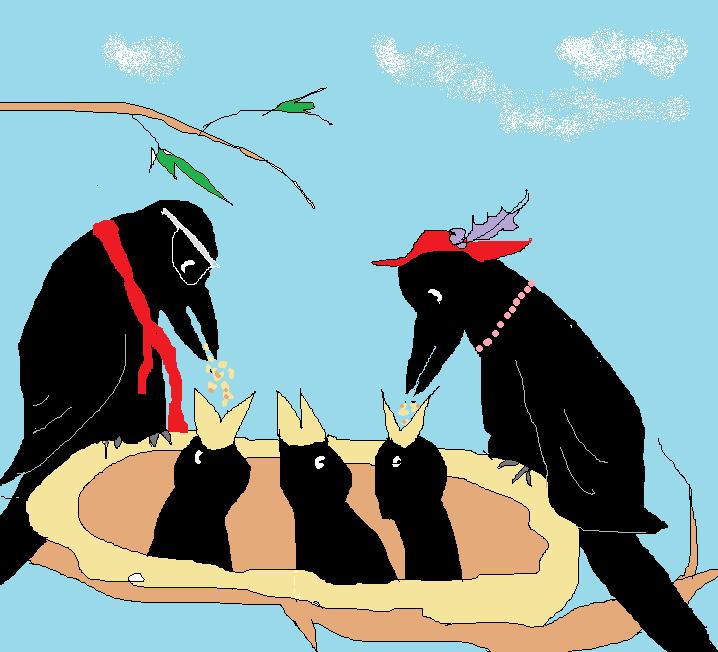
Well, that's all the crow news I've got for today. Except, to save my sister, Jenn, from having to send me a comment about how I should have properly dressed the crows for my blog, here is how I imagine that Corvina and Bertram would have met and fell in love IF they were in fact people dressed up as crows dressed up as people.

submit to reddit